
By Dr. Beth Collins, double board-certified plastic surgeon
A facelift and eyelid surgery are often performed in the same operation, and for the right patient that means one recovery and a result where the eyes match the rest of the face. Combining them is not automatically the better choice, though. It lengthens surgery and adds a modest amount of risk, so the decision should come from a careful exam rather than a package deal.
Here is what each procedure does, why they are paired so often, and how to weigh the trade-offs honestly.
Why these two procedures are so often paired
A facelift and eyelid surgery treat different parts of the face. A facelift addresses sagging jowls, a softened jawline, deep folds around the mouth, midface descent, and loose neck skin. It does not change the eyelids.
That is why some patients who have only a facelift notice a mismatch afterward: a crisp jawline paired with eyes that still look heavy or tired. Eyelid surgery, also called blepharoplasty, treats the area a facelift cannot reach. Upper eyelid surgery removes excess, hooded skin and can reduce puffiness. Lower eyelid surgery addresses under-eye bags and puffiness.
When both areas show similar signs of aging, treating them together can produce a more balanced, natural result.
What each procedure involves
At The Collins Center, Dr. Collins uses a deep plane facelift technique, which lifts and repositions the deeper tissues of the face as a single unit rather than simply tightening skin.
The benefits of combining them
One anesthesia and one recovery. When procedures heal at the same time, you plan for a single recovery window instead of two separate ones spread months apart.
One block of time away from work and social plans. For many patients this is the deciding factor.
A result planned as a whole. When a surgeon plans the jawline, midface, and eyes together, the proportions can be balanced from the start rather than adjusted piece by piece.
Often, one set of facility and anesthesia fees. Your quote will depend on your plan, but combining procedures can avoid paying for a second operating session. See our guide to facelift cost in Connecticut for what goes into a surgical quote.
The trade-offs to weigh honestly
Combining procedures is common and generally safe in experienced hands, but it is not risk-free.
A large study published in Aesthetic Surgery Journal reviewed 11,300 facelift patients in the CosmetAssure database. More than half of the facelifts, 57.4%, were performed together with other cosmetic procedures. Major complications, defined as problems requiring an emergency room visit, hospital admission, or a return to surgery within 30 days, occurred in 1.8% of facelift patients overall. The rate was 1.5% for facelifts done alone and up to 3.7% when combined with other procedures. The researchers also found that combined procedures and a higher body mass index were each linked to a higher risk of infection.
What that means in practice:
A longer operation carries somewhat more risk than a shorter one.
Your overall health matters. Conditions such as diabetes, a higher body weight, or nicotine use can affect whether combining is the safest plan.
Some patients are better served by staging procedures, for example, eyelid surgery now and a facelift later, or the reverse.
Dr. Collins participates in the CosmetAssure program, which covers patients against unexpected complications from covered elective procedures. Ask about it at your consultation.
Sometimes the eyelids are not the real issue
Heavy upper lids are not always caused by excess eyelid skin. A brow that has descended over time can push skin down onto the upper lid. In that case, removing eyelid skin alone may not give the refreshed result a patient expects, and a brow lift or a combined brow and facelift may address the cause more directly.
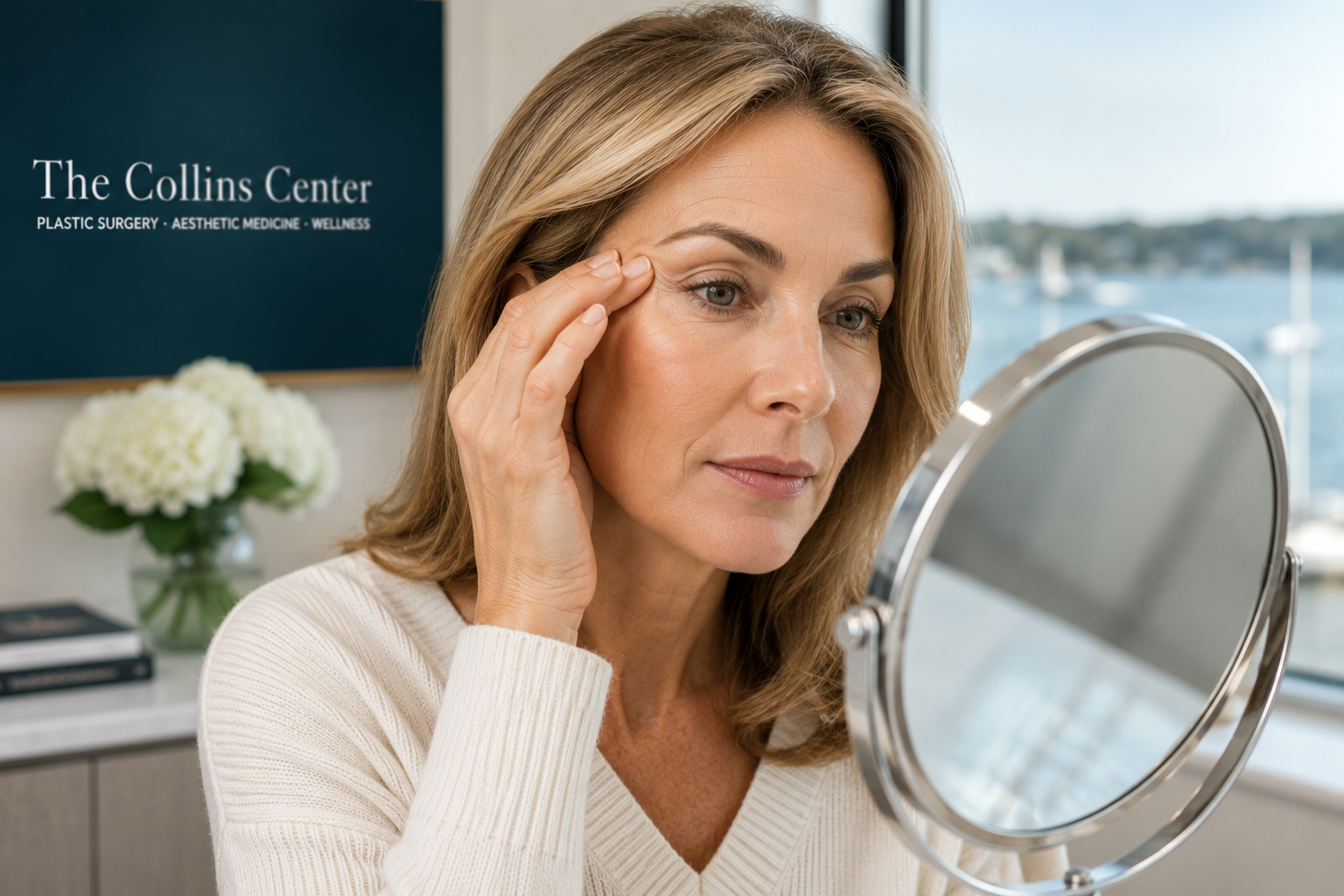
This is one reason a hands-on evaluation matters. The right plan depends on what is actually causing the change you see in the mirror.

What recovery looks like when you combine them
Your recovery will follow the longer of the two procedures, which is the facelift. Based on the typical recovery described for these procedures at The Collins Center:
First two weeks: Swelling and bruising around the face and eyes are expected. You will keep your head elevated, and cold compresses can help with swelling around the eyes.
Around 10 to 14 days: Most social healing takes place in this window. Many patients return to desk work in about two weeks.
Four to six weeks: Strenuous exercise usually resumes around this point, with your surgeon’s approval.
Several months: Final results appear as residual swelling resolves.
Every recovery is individual. You will receive detailed pre- and post-operative instructions for your specific plan.
Other procedures sometimes added
Depending on your goals, Dr. Collins may discuss adding:
Facial fat grafting to restore volume in areas such as the cheeks or under the eyes
A brow lift when brow position contributes to heaviness around the eyes
Laser skin resurfacing to improve skin texture, since surgery lifts and repositions tissue but does not change skin quality
More procedures are not always better. The goal is the smallest plan that achieves a natural, rested result safely.
Who is a good candidate for combined surgery?
You may be a good candidate if:
You have sagging along the jawline or neck and also heavy upper lids or under-eye bags
You are in good overall health
You do not smoke or use nicotine, or are willing to stop completely before and after surgery
You have no serious eye conditions that would make eyelid surgery unsafe
You would prefer one recovery period rather than two
You have realistic expectations and want to look refreshed, not different
Questions to ask at your consultation
Is my upper-lid heaviness caused by eyelid skin, brow position, or both?
Would you recommend combining these procedures or staging them for me? Why?
How long will my surgery take, and where will it be performed?
What will my recovery look like week by week?
What does my quote include?
What to do next
The best way to know whether combining a facelift and eyelid surgery makes sense for you is an in-person evaluation. You can see examples of Dr. Collins’s work in our facelift gallery and eyelid surgery gallery.
Ready to talk through your options? Schedule a consultation with Dr. Collins at the office closest to you:
Guilford: Willow Hall, 2614 Boston Post Road, Suite 16C, Guilford, CT 06437 · (203) 689-5295 · Book at Guilford
Mystic: 55 Willow Street, Mystic, CT 06355 · (860) 572-6868 · Book at Mystic
You can also start with our online consultation form.
Frequently asked questions
Will combining a facelift and eyelid surgery make me look overdone?
It should not. A natural result depends on careful planning and restraint, not the number of procedures. The aim is for your eyes and lower face to look equally rested, so the result reads as you, only refreshed.
How long does combined facelift and eyelid surgery take?
A facelift alone typically takes about two to three hours, and eyelid surgery adds time depending on whether the upper lids, lower lids, or both are treated. Your surgeon will give you an estimate based on your plan.
Can I have eyelid surgery now and a facelift later?
Yes. Staging procedures is a reasonable option, especially if one area bothers you much more than the other or if your health makes a shorter operation the safer choice.
Is recovery twice as long when I combine procedures?
No. Both procedures heal at the same time, so you plan around a single recovery window. Expect it to follow the facelift timeline, with extra swelling and bruising around the eyes in the first couple of weeks.
This article is for general education and is not medical advice. Results vary, and every procedure carries risks. A consultation with a board-certified plastic surgeon is the best way to learn which options are right for you.
About the author
Dr. Beth Collins is a double board-certified plastic surgeon, certified in both general surgery and plastic surgery, and the founder of The Collins Center in Guilford and Mystic, Connecticut. She completed her fellowship in plastic and reconstructive surgery at Emory University, followed by a specialty fellowship in breast shaping and body contouring. Dr. Collins has been in practice for more than 16 years and performs an average of one to two facelifts a week, with a focus on the deep plane technique. She is a clinical instructor who teaches cosmetic surgery to surgical residents at Yale, has spoken on panels at the American Society of Plastic Surgeons and the Women’s Plastic Surgery Conference, and has been named a Castle Connolly Top Doctor (2023–2024).