
The best plastic surgeon for you is one who is certified by the right board, performs your specific procedure often, operates in an accredited setting, and tells you honestly what surgery can and cannot do. Rankings and “best of” lists can help you build a shortlist, but they can’t answer those questions for you. This checklist walks through how to verify each one, whether you’re in New Haven County, along the shoreline, or in southeastern Connecticut.
Why “best of” lists are a starting point, not an answer
Most “best plastic surgeon” lists fall into one of three types: reader polls run by local publications, peer-nominated directories, and paid or advertising-driven listings. Each measures something different. A reader poll reflects local reputation. A peer-nominated directory reflects how other physicians view a surgeon. A paid listing reflects a marketing budget.
None of them confirms that a surgeon is trained and certified in plastic surgery or experienced with the procedure you want. Before you rely on any award, check who gives it, how recipients are chosen, and what year it covers. That applies to every practice you’re considering, including ours.
Step 1: Confirm board certification, and ask “by which board?”
“Board-certified” on its own doesn’t tell you much. Physicians can be certified in many specialties, and some certifying organizations have official-sounding names but different training and exam standards.
In the United States, the American Board of Plastic Surgery (ABPS) is the only board recognized by the American Board of Medical Specialties to certify surgeons in plastic surgery, as The Aesthetic Society explains in its guide to plastic surgeon board certification. ABPS certification means the surgeon completed specialty training and passed written and oral exams covering the full scope of plastic surgery.
If a surgeon describes themselves as “double board-certified,” ask which two boards. It’s a fair question, and a confident surgeon will answer it directly.
How to check it yourself:
- Search the surgeon’s name on the American Board of Plastic Surgery website.
- Confirm other specialty certifications through the American Board of Medical Specialties’ Certification Matters lookup.
- Make sure the name you verify matches the surgeon who will actually perform your operation, not just the practice owner.
Step 2: Check the surgeon’s Connecticut medical license
Board certification and a medical license are different things. A license is the legal minimum to practice medicine; certification reflects specialty training beyond it. You can confirm that a physician holds an active Connecticut license, and review the license details, through the state’s free Connecticut eLicense license lookup, maintained by the Department of Public Health.
Step 3: Ask how often they perform your procedure
A surgeon can be well trained and still perform your particular operation only occasionally. Ask how often they do it, not to chase a big number, but to understand whether it’s a routine part of their practice. The American Society of Plastic Surgeons lists procedure frequency among the questions it recommends asking during a consultation.
Repetition builds precision. At The Collins Center, for example, Dr. Beth Collins averages one to two facelifts a week, and deep plane facelift is a central focus of her surgical practice. That kind of specific answer is what you’re listening for, wherever you consult.
Step 4: Ask where your surgery will be performed
This question often gets skipped, and it matters. Ask:
- Where exactly will my surgery take place?
- Is the facility accredited by a nationally or state-recognized agency, state-licensed, or Medicare-certified?
- Does the surgeon hold hospital privileges for this procedure?
- Who administers and monitors anesthesia?
Accredited facilities have been reviewed for their ability to handle emergencies, and hospital privileges mean a hospital has independently credentialed the surgeon for that type of operation.
Step 5: Look at real results for your procedure
Before-and-after photos are most useful when they show your procedure on patients with a similar starting point: similar age, skin quality, and anatomy. Look for consistency across many patients rather than one standout result, and ask the surgeon what a realistic outcome looks like for you. You can review The Collins Center’s photo gallery as one example of what to look for. Every patient heals differently, and results vary.
Step 6: Pay attention to how the consultation feels
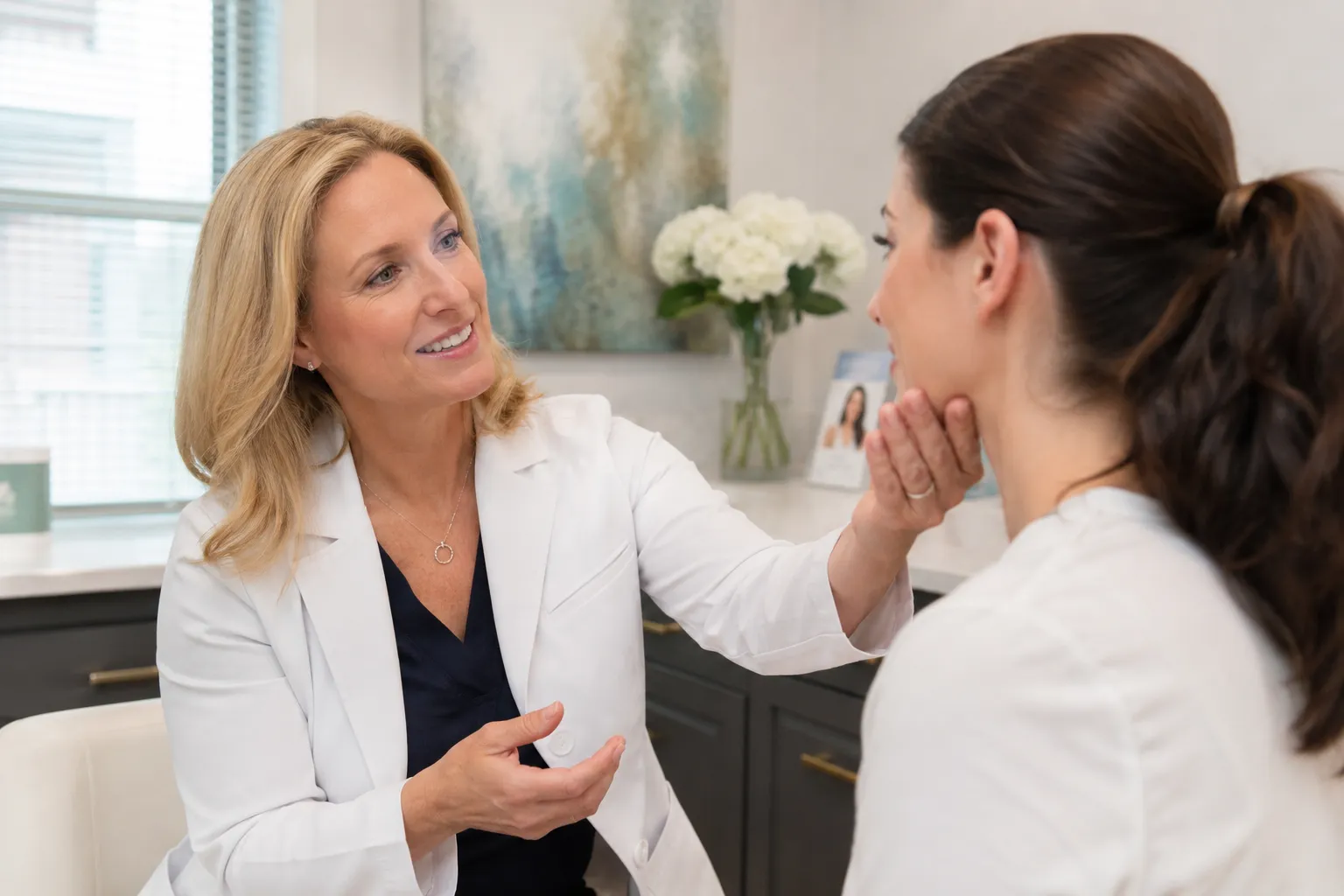
A good consultation is unhurried and specific. You should leave understanding the plan, the recovery, and the risks.
Signs of a strong consultation:
- The surgeon examines you and explains what they see in plain language.
- Risks and recovery are discussed openly, not glossed over.
- Alternatives are on the table, including non-surgical options or waiting.
- The surgeon is willing to tell you a procedure isn’t right for you.
Reasons to pause:
- Pressure to book before you’ve had time to think.
- Vague answers about board certification, facility, or who performs each step.
- Promises of guaranteed results, “no downtime,” or a dramatic transformation.
Getting a second opinion from another board-certified plastic surgeon is normal, and a confident surgeon won’t mind.
Step 7: For non-surgical treatments, ask who performs them
Injectables, lasers, and skin treatments are often delivered by nurses or physician assistants. That can be entirely appropriate, but you should know who is treating you, how they were trained, and whether a physician oversees the plan. Ask whether a board-certified surgeon is involved in decisions about your care.
At The Collins Center, non-surgical treatments are performed by a physician assistant and nurses whom Dr. Collins personally selected and trained, under her oversight. You can meet the team before booking.
How The Collins Center measures up
We’d encourage you to run this checklist on us, too. Here’s what you’ll find:
- Training: Dr. Beth Collins is a double board-certified plastic surgeon. She completed a plastic and reconstructive surgery fellowship at Emory University, followed by a specialty fellowship in breast shaping and body contouring.
- Experience: She has been in practice for more than 16 years, opening her Guilford office in 2011 and her Mystic office in 2021.
- Focus: Facial rejuvenation, including facelift and deep plane facelift, and body contouring.
- Teaching: She is a clinical instructor for surgical residents at Yale and has spoken on panels at the American Society of Plastic Surgeons meeting.
- Recognition: New Haven Register Best Plastic Surgeons in New Haven (2023 and 2024) and Castle Connolly Top Doctor (2026).
- Patient protection: Dr. Collins participates in CosmetAssure, a program that covers patients for unexpected complications from covered elective procedures.
The idea behind the practice is simple: a surgeon, not a salesperson, decides what each patient actually needs. That means surgery when it’s the right tool, non-surgical care when it isn’t, and an honest answer either way.
Guilford or Mystic: which office should you choose?
Both offices are led by Dr. Collins, so the choice usually comes down to convenience. The Guilford office on Boston Post Road is a practical option for patients from New Haven County and the central shoreline, including Madison, Branford, and New Haven. The Mystic office on Willow Street serves southeastern Connecticut, including Stonington, Groton, and New London, along with nearby Rhode Island.
What to do next
- Make a shortlist of two or three surgeons.
- Verify each surgeon’s ABPS certification and Connecticut license using the links above.
- Bring the questions from Steps 3 through 6 to each consultation.
- Take notes, compare, and give yourself time to decide.
If you’d like to talk through your goals with Dr. Collins, you can schedule a consultation at either office:
- Guilford: Book online or call (203) 689-5295
- Mystic: Book online or call (860) 572-6868
You can also start with our online consultation form.
Frequently asked questions
What does “double board-certified” mean?
It means a physician holds certification from two separate specialty boards. The phrase alone doesn’t tell you which boards, so ask. For plastic surgery, look for certification by the American Board of Plastic Surgery as one of them.
Is a cosmetic surgeon the same as a plastic surgeon?
Not necessarily. Any licensed physician can legally perform cosmetic procedures, and some hold certifications from boards other than the ABPS. A board-certified plastic surgeon has completed accredited plastic surgery training and passed the ABPS exams. Ask any surgeon directly what they are certified in and by whom.
How many surgeons should I consult with?
Many patients meet with two or three. Comparing consultations helps you see how different surgeons approach your concern and which one explains your options most clearly.
This article is for general education and is not medical advice. Results vary, and every procedure carries risks. A consultation with a board-certified plastic surgeon is the best way to learn which options are right for you.