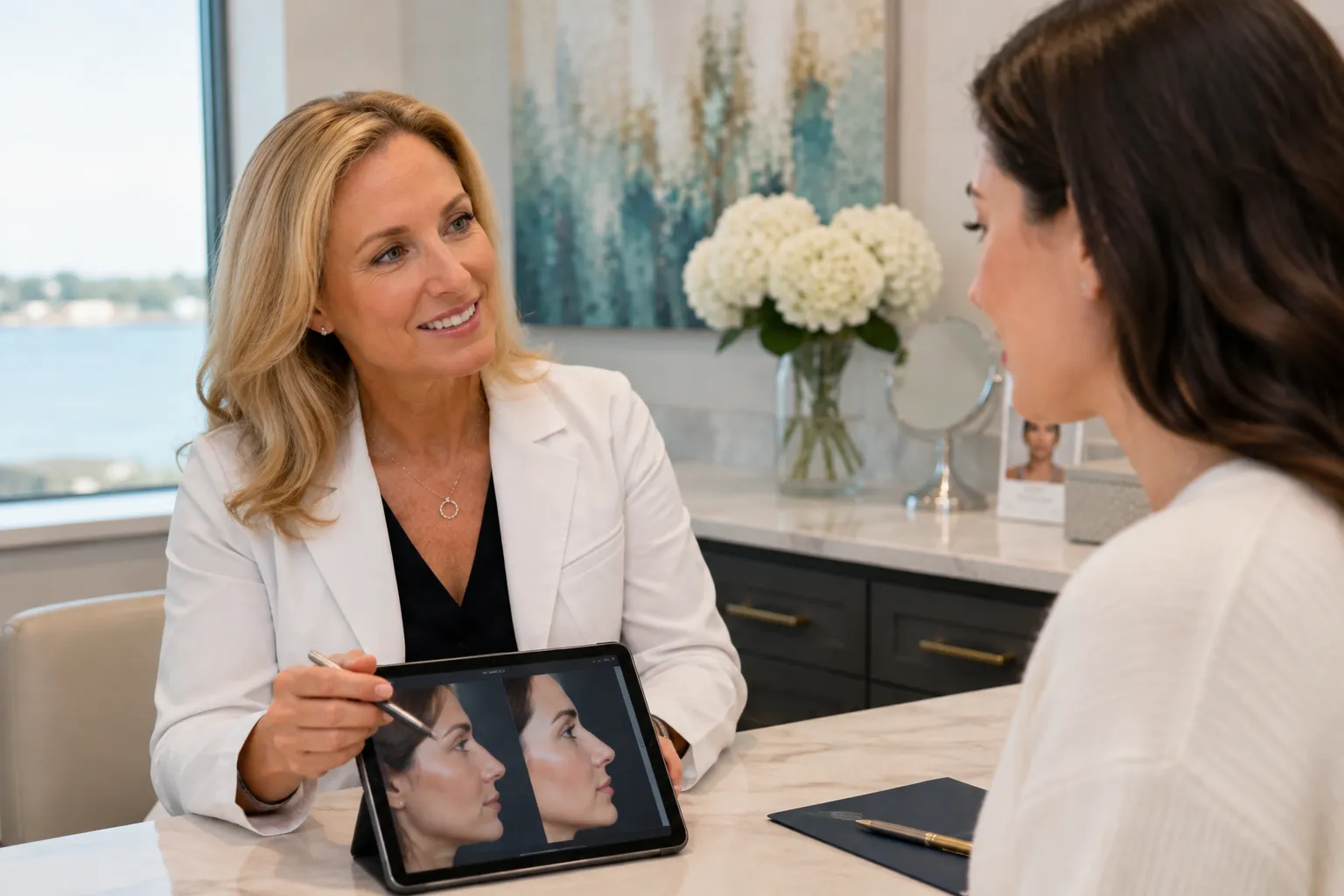

Facial aging doesn’t happen all at once, and it doesn’t happen the same way everywhere on the face. Sagging jowls, hollow cheeks, heavy eyelids, and sun spots each have different causes, so each responds to a different treatment. Some changes need surgery. Many don’t. This guide walks through the face zone by zone so you can see which options fit which concern before your consultation.
Why the face ages in layers
Aging affects several layers of the face at the same time. The skin thins and loses elasticity. Fat pads that once kept the cheeks full shrink and shift downward. The deeper supportive tissues loosen, which lets the lower face and neck sag. Sun exposure, smoking, genetics, and stress all speed the process.
That layered picture explains why no single treatment fixes everything. According to the American Society of Plastic Surgeons’ overview of facelift surgery, a facelift targets sagging in the face and neck. It doesn’t change the skin’s surface or stop the aging process. Treatments for the eyes, brow, volume, and skin quality are often added to match the rest of the face.
Forehead and brow
Lines that appear when you move your face (forehead creases, frown lines between the brows) are usually caused by repeated muscle movement. Neuromodulators such as Botox® Cosmetic, Dysport®, and Daxxify® relax those muscles to soften the lines. Results are temporary and need maintenance.
A brow that has dropped, making the eyes look heavy or tired, is a structural change. A brow lift repositions the brow surgically. When the brow and lower face both need attention, a brow facelift addresses them together.
Eyes
Crow’s feet respond to neuromodulators, the same way forehead lines do.
Hollows under the eyes are often caused by volume loss. Under-eye fillers or tear trough fillers can soften them in the right candidate.
Excess upper eyelid skin can’t be treated with injectables. Upper eyelid surgery removes it. Puffy bags under the eyes from shifted fat are addressed with lower eyelid surgery.
Cheeks and midface
Flattened or hollow cheeks usually reflect lost volume. Hyaluronic acid fillers restore volume directly. Sculptra® works more gradually by stimulating the body’s own collagen. Face fat grafting uses your own fat as a longer-lasting option, often combined with surgery.
Cheeks that have slid downward, deepening the folds beside the nose, are a structural descent. Filler can soften the look of the folds, but repositioning the tissue itself takes a facelift.
Jowls, jawline, and neck
This is where surgery makes the biggest difference. Jowls, a blurred jawline, and loose neck skin come from deeper tissues that have loosened and dropped. Non-surgical treatments can improve mild changes or skin quality, but they can’t lift sagging tissue back into place.
A facelift addresses the lower face and neck. A deep plane facelift releases and repositions the deeper tissue layers as a unit, rather than relying on tightening the skin. Deep plane facelift is a central focus of Dr. Beth Collins’s surgical practice. She averages one to two facelifts a week. If you’re weighing facelift surgery, our guide to what to expect from a modern facelift covers the process in more detail.
Mouth and lips
Thinning lips respond well to lip fillers. The goal is restored shape and balance, not size.
A lengthened upper lip, where the space between the nose and lip grows longer with age and the upper teeth show less, is a structural change filler can’t correct. An upper lip lift shortens that space surgically.
Skin surface: texture, tone, and sun damage
Even a well-lifted face can look older than it should if the skin surface shows sun spots, redness, uneven texture, or fine lines. Surgery doesn’t change the skin itself, so these concerns are treated separately:
- Brown spots and redness: BBL® laser
- Texture, fine lines, and overall skin quality: Halo™ laser, Moxi™ laser, microneedling, and chemical peels
- Deeper resurfacing: Corrective Laser Restoration
Consistent sunscreen and medical-grade skin care help protect results from any treatment.
Why most plans combine treatments
Most people notice several changes at once: some sagging, some volume loss, some sun damage. Treating only one can create a mismatch, such as a lifted jawline paired with tired-looking eyes or sun-damaged skin. The American Society of Plastic Surgeons notes that brow lift, eyelid surgery, fat transfer or fillers, and skin treatments are commonly combined with a facelift for this reason.
Combining treatments doesn’t have to mean doing everything at once. A plan might pair surgery with skin treatments afterward, or begin with non-surgical care and revisit surgery later. The right sequence depends on your face, your health, and your timeline.
Surgery or non-surgical: how the decision gets made
Four questions usually guide the choice:
- How much laxity is there? Mild changes often respond to non-surgical care. Significant sagging in the jowls and neck usually needs surgery.
- How much recovery time can you plan for? Surgery involves real downtime and carries surgical risks. Non-surgical treatments typically involve less, though they aren’t risk-free.
- How long do you want results to last? Injectables and many skin treatments are temporary and need maintenance. Surgery offers a longer-lasting change, though the face continues to age afterward.
- What’s your overall health? Some medical conditions and medications affect candidacy for surgery.
At The Collins Center, these decisions are led by a surgeon. Dr. Collins, a double board-certified plastic surgeon, built the practice so that surgery, injectables, lasers, and skin care sit under one roof, with a physician, not a sales incentive, deciding what each patient needs. Non-surgical treatments are performed by a physician assistant and nurses she personally trained, under her oversight.
What to do next
A consultation is the best way to see which of these options fit your face. Bring photos of yourself from a few years ago if you have them. They help show which changes bother you most.
- Guilford: Book online or call (203) 689-5295
- Mystic: Book online or call (860) 572-6868
You can also start with our online consultation form or browse all facial aging treatments. If you’re still comparing practices, our checklist for choosing a plastic surgeon in Connecticut can help.
Frequently asked questions
Can non-surgical treatments replace a facelift?
Not for significant sagging. Injectables, lasers, and skin treatments can improve volume, lines, and skin quality, and they may delay the point at which a facelift makes sense. They can’t reposition loosened tissue the way surgery does.
Is there a right age for facial surgery?
No. Candidacy depends on the degree of change in your face, your health, and your goals, not a number. Some people benefit from surgery earlier, and others do well with non-surgical care for years.
Can I combine a facelift with other procedures?
Often, yes. Eyelid surgery, brow lift, and fat grafting are commonly performed during the same operation as a facelift. Your surgeon will advise whether combining procedures is safe and sensible for you.
Will a facelift stop my face from aging?
No. A facelift resets the clock on sagging, but aging continues afterward. Good skin care, sun protection, and maintenance treatments help results age well.
This article is for general education and is not medical advice. Results vary, and every procedure carries risks. A consultation with a board-certified plastic surgeon is the best way to learn which options are right for you.